
















Bihar Politics After Nitish Kumar’s Rajya Sabha Move: The End of an Era or a Strategic Transition?
Bihar Chief Minister Nitish Kumar's strategic move to the Rajya Sabha marks the end of a decades-long political era, opening the doors for the state's potential first-ever BJP Chief Minister. As contenders like Samrat Choudhary and Nityanand Rai lead the race, the JD(U) faces a tough battle for survival without its core face.

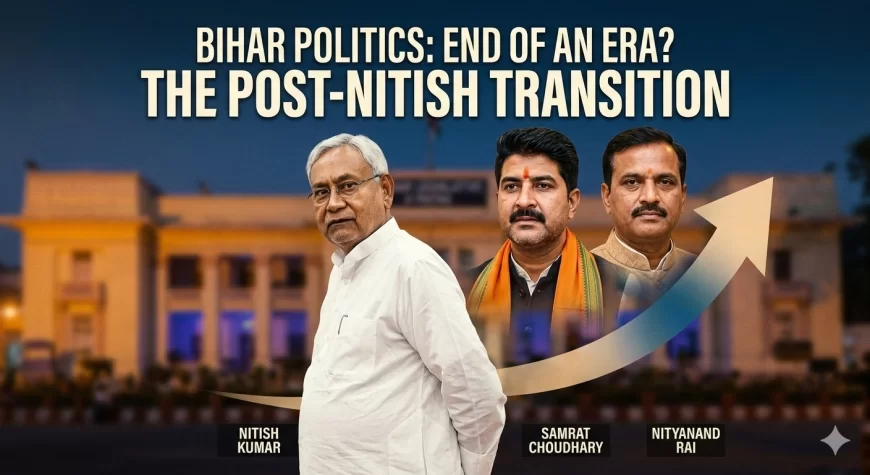
Leadership transitions do not always transform the political structure of a state. Occasionally, however, a single decision signals a deeper realignment of political power. The decision of Nitish Kumar to move to the Rajya Sabha reflects a deeper transformation in Bihar’s coalition politics. For nearly two decades, the state’s politics revolved around Kumar’s leadership, administrative style, and coalition management. His departure from the chief minister’s office therefore marks more than the end of an individual tenure; it reflects a structural shift in the balance of power within the state’s political system. Similar leadership transitions in states such as Maharashtra have demonstrated how shifts within coalition structures can gradually transform the balance of power between regional parties and national parties.
To understand the significance of this transition, it is important to place it within the longer arc of Bihar’s political evolution. Since the 1990s, the state’s political landscape has been defined largely by the competing legacies of Lalu Prasad Yadav and Nitish Kumar. While Lalu Prasad Yadav’s politics was rooted in the mobilization of backward caste identities and the language of social justice, Nitish Kumar constructed a governance narrative centred on development, administrative reform, and coalition pragmatism. For nearly three decades, this rivalry shaped Bihar’s political imagination. Kumar’s decision to move to the Rajya Sabha therefore symbolically signals the gradual closure of a political era that has defined the state’s electoral and governance dynamics for a generation. Yet the real significance of this development lies not only in the end of a political era, but also in the changing balance of power within the National Democratic Alliance led by the Bharatiya Janata Party.
Changing Power Dynamics within the NDA
The evolution of the alliance between the BJP and the Janata Dal (United) reflects broader shifts in Indian coalition politics. In the early years of their partnership, JD(U) was the dominant regional force in Bihar while the BJP played a supporting role. Nitish Kumar’s political credibility and governance record allowed the party to occupy the central space in the coalition. Over the past decade, however, the BJP has expanded its organizational presence and electoral base across the Hindi heartland. Bihar was one of the few major states where the party had not yet held the chief minister’s office despite being a significant coalition partner. Kumar’s move to the Rajya Sabha now creates a political opening for the BJP to assume direct leadership in the state government.
If this transition materializes, Bihar may witness its first BJP chief minister, with figures such as Samrat Choudhary and Nityanand Rai frequently mentioned as potential contenders. Such a development would mark the culmination of a long political strategy aimed at expanding the party’s influence across northern India. This transition can also be interpreted within the broader evolution of India’s party system. Scholars of Indian politics have long observed that coalition politics at the state level often produces phases of regional party dominance followed by periods of consolidation by national parties. In Bihar, the political system for many years revolved around the leadership of figures such as Lalu Prasad Yadav and Nitish Kumar, whose authority shaped both electoral competition and governance narratives. The current transition, however, suggests that this personality-centric regional order may be gradually giving way to a political configuration in which national parties exercise greater structural influence. The expanding role of the Bharatiya Janata Party within the alliance therefore reflects not merely a leadership change but a deeper transformation in the balance between regional and national political forces. In this sense, Bihar’s political transition mirrors a broader trend in Indian federal politics where national parties increasingly consolidate authority in states that were once dominated by regional leadership.
The JD(U)’s Strategic Dilemma
While the leadership change may strengthen the BJP’s position within the alliance, it simultaneously raises critical questions about the future of JD(U). Unlike many regional parties that cultivate a strong second-line leadership, JD(U) has historically relied heavily on Nitish Kumar’s personal political authority. This dependence makes the transition particularly delicate. Without Kumar at the helm, the party must redefine both its leadership structure and its ideological positioning within the alliance. The recent entry of Kumar’s son, Nishant Kumar, into active politics may represent an attempt to maintain organizational continuity and preserve the party’s political legacy. Yet the broader challenge remains structural rather than personal. Regional parties often struggle to maintain relevance when national parties expand their influence within coalition arrangements. JD(U) now faces the task of preserving its political identity while operating within an alliance increasingly dominated by the BJP.
Opposition Politics and the Question of Mandate
The leadership transition has also triggered strong reactions from the opposition, particularly the Rashtriya Janata Dal led by Tejashwi Yadav. Opposition leaders argue that the shift undermines the electoral mandate, suggesting that voters supported the alliance under Nitish Kumar’s leadership rather than under a BJP chief minister. He accused the BJP of a “Maharashtra-style” power grab, saying the change “is against the mandate of the people”. Congress spokesperson Jairam Ramesh called it a “leadership coup” by the Modi-Shah “G2” and “a huge betrayal of the mandate of the people”
Such criticism reflects a broader tension within coalition politics. Electoral alliances often depend heavily on the credibility of individual leaders. When leadership changes occur soon after elections, they can create perceptions that the mandate has been reinterpreted or reshaped through post-electoral negotiations. At the same time, leadership transitions are not uncommon in coalition governments, where internal power adjustments frequently reshape political arrangements. The debate therefore highlights a fundamental question about democratic mandates in coalition systems: whether they belong primarily to individual leaders or to the alliances that contest elections collectively.
Bihar’s Political Future And Post-Nitish Political Order
The transformation underway in Bihar can also be understood within a larger theoretical framework of Indian politics. Political scientist Rajni Kothari once described Indian politics as a dynamic system in which dominant political formations periodically reorganize themselves through alliances and leadership shifts. Bihar’s current transition appears to reflect such a moment of political reconfiguration.
Three key trends are likely to shape the state’s future trajectory. First, the BJP’s expanding political influence may fundamentally reshape the balance of power within the NDA. Second, the survival and adaptation of JD(U) will depend on whether it can evolve beyond its reliance on Nitish Kumar’s leadership. Third, opposition forces led by the RJD will attempt to exploit any political space created by this transition. In addition, for Bihar’s electorate, the coming years will test whether the new leadership arrangement delivers administrative continuity and development outcomes comparable to the Nitish era.
Ultimately, Nitish Kumar’s departure from the chief minister’s office marks the beginning of a new phase in Bihar politics. For nearly two decades, the state’s political narrative revolved around his leadership and his rivalry with Lalu Prasad Yadav. That political framework is now gradually dissolving. As the BJP consolidates its position and regional parties attempt to adapt to the new balance of power, Bihar’s politics may shift from personality-driven competition toward a different form of political alignment shaped by national party dominance. Whether this transformation produces greater stability or intensifies political contestation remains uncertain. What is clear, however, is that Bihar is entering a post-Nitish phase—one that will redefine the state’s political trajectory for years to come.
About the Authors
Dr Rakesh Negi is an Assistant Professor of Political Science specializing in Indian politics, with particular focus on state and national political dynamics. His academic work explores governance, party systems, and coalition politics in India. Through research and teaching, he contributes to the understanding of contemporary political developments and democratic processes in the country.
Ritik Kumar is a Research Scholar with a strong interest in Indian politics and public policy. His research focuses on state-level political developments, electoral dynamics, and governance. He collaborates on academic and analytical writings that examine contemporary political trends and policy debates in India.
About the Author: Ritik Chaudhary is a Research Scholar with a strong interest in Indian politics and public policy. His research focuses on state-level political developments, electoral dynamics, and governance in India.
Note: The opinions expressed are solely those of the author.
What's Your Reaction?
 Like
3
Like
3
 Dislike
0
Dislike
0
 Love
0
Love
0
 Funny
0
Funny
0
 Angry
0
Angry
0
 Sad
0
Sad
0
 Wow
1
Wow
1