




















Nari Shakti Vandan Adhiniyam: The Key to Women's Political Empowerment in India
The Nari Shakti Vandan Adhiniyam (Women’s Reservation Bill) aims to reserve 33 percent of seats for women in the Lok Sabha and State Legislative Assemblies, addressing deep-rooted structural imbalances in Indian politics. Although the bill has faced legislative hurdles and criticisms regarding its reliance on future delimitation and the absence of an OBC sub-quota, it remains a transformative piece of legislation.

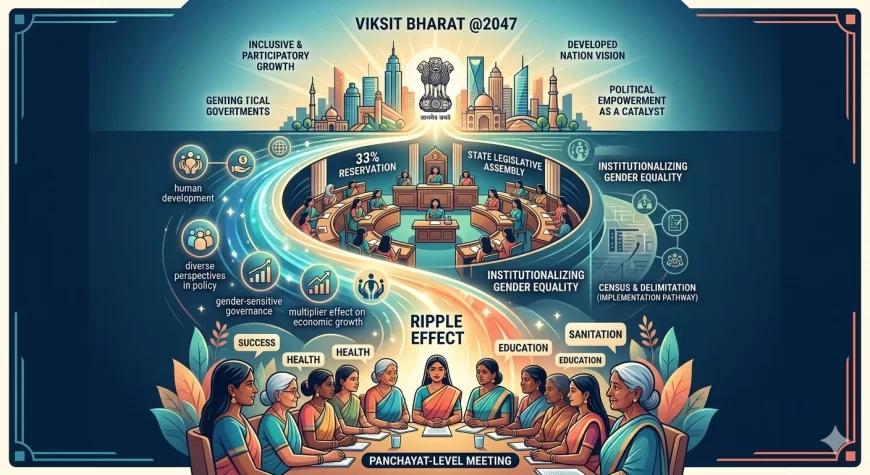
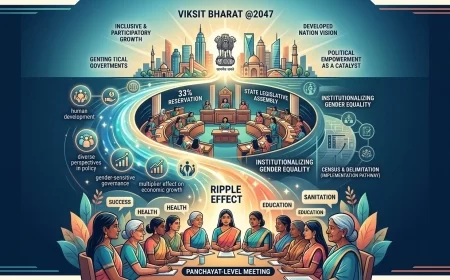
The question of women’s political representation in India has long occupied a central place in debates on democratic deepening and social justice. The proposed Nari Shakti Vandan Adhiniyam, also known as the Women’s Reservation Bill, represents one of the most significant attempts to address the structural underrepresentation of women in legislative bodies. Although the bill has recently faced a setback in the Lok Sabha, its underlying vision and transformative potential remain compelling. At its core, the legislation seeks to reserve 33 percent of seats in the Lok Sabha and State Legislative Assemblies for women, thereby institutionalizing gender equality in political representation. In doing so, it aligns closely with India’s broader developmental aspirations—particularly the vision of Viksit Bharat @2047, which emphasizes inclusive and participatory growth.
Historically, the demand for women’s reservation in India’s legislatures dates back to the 1990s, when the issue first gained legislative traction. Despite repeated attempts through constitutional amendments, the bill failed to materialize into law due to political disagreements and a lack of consensus. Meanwhile, women’s representation in Parliament has remained disproportionately low, hovering around 15 percent in the Lok Sabha, with even lower figures in many State Assemblies. This persistent gap highlights a structural imbalance that cannot be addressed through incremental changes alone. The Nari Shakti Vandan Adhiniyam, therefore, emerges as a necessary corrective measure aimed at ensuring that women, who constitute nearly half of the population, have a meaningful voice in governance.
The need for such a measure becomes clearer when considering the multiple barriers women face in entering politics. These barriers are not merely individual but systemic—rooted in socio-cultural norms, economic constraints, and institutional biases. Patriarchal attitudes often discourage women from pursuing political careers, while limited access to financial resources and political networks further restricts their participation. In this context, reservation serves not as a privilege but as an instrument of justice, enabling women to overcome entrenched inequalities and participate on a more equal footing. It is a recognition that formal equality alone is insufficient in the absence of substantive measures to level the playing field.
India’s experience with reservation for women at the grassroots level provides strong empirical support for extending similar provisions to higher legislative bodies. The 73rd and 74th Constitutional Amendments, which mandated reservation for women in Panchayati Raj Institutions and urban local bodies, have had a transformative impact. In several states, the quota has been increased to 50 percent, resulting in a significant rise in women’s participation in local governance. Studies and field observations indicate that women representatives have contributed to more inclusive decision-making, placing greater emphasis on issues such as health, education, sanitation, and social welfare. Moreover, the presence of women in leadership roles has had a ripple effect, inspiring greater political awareness and participation among other women in the community. This success story at the grassroots level strengthens the case for replicating the model at the state and national levels.
From a democratic perspective, the Nari Shakti Vandan Adhiniyam has the potential to make India’s political system more inclusive and representative. A democracy that does not adequately reflect the diversity of its population risks becoming exclusionary and unresponsive. By ensuring a critical mass of women in legislative bodies, the bill would broaden the social base of political power and bring new perspectives into policymaking. Women legislators are more likely to raise issues that have historically been neglected, thereby enriching the quality of legislative debates and outcomes. This, in turn, enhances the legitimacy and credibility of democratic institutions.
Beyond its democratic implications, the bill also carries significant developmental benefits. There is growing evidence from across the world that women’s political participation is positively correlated with better governance outcomes. Women leaders often prioritize social sectors such as education, healthcare, and welfare, which are crucial for human development. In the Indian context, greater representation of women in legislatures could lead to more gender-sensitive policies and increased investment in areas that directly impact the well-being of families and communities. This has a multiplier effect on economic growth, as improvements in health and education contribute to a more productive workforce. Thus, the Nari Shakti Vandan Adhiniyam is not merely a political reform but a strategic intervention aimed at fostering inclusive development.
The bill’s relevance becomes even more pronounced when viewed in the context of Viksit Bharat @2047, India’s vision of becoming a developed nation by the centenary of its independence. Achieving this goal requires harnessing the full potential of all sections of society, including women. Political empowerment is a critical component of this process, as it enables women to influence decision-making and shape development priorities. Without adequate representation in legislative bodies, women’s voices are likely to remain marginalized, limiting the effectiveness of policies aimed at their empowerment. The Nari Shakti Vandan Adhiniyam, by ensuring a substantial presence of women in politics, contributes directly to the realization of this vision.
At the same time, the bill has not been without its critics. One of the main concerns relates to its implementation being contingent upon the completion of the next census and the subsequent delimitation exercise. Critics argue that this linkage could delay the actual realization of women’s reservation. While this concern is valid, it is important to recognize that delimitation is a necessary step to ensure the fair and equitable distribution of seats. Rather than undermining the bill, this provision seeks to strengthen its implementation by aligning it with constitutional requirements. Another criticism pertains to the absence of a sub-quota for women from Other Backward Classes (OBCs). While the demand for greater inclusivity is legitimate, it should not become a reason to stall the entire reform. The current bill provides a foundational framework, which can be refined and expanded through future legislative measures.
The recent failure of the bill to secure passage in the Lok Sabha underscores the continuing challenges in achieving political consensus on issues of gender justice. It reflects not only partisan divisions but also a deeper societal ambivalence towards women’s empowerment in the political sphere. However, this setback should not be seen as the end of the road. Instead, it highlights the need for renewed efforts to build consensus and mobilize public support for the bill. The widespread debate surrounding the legislation has already contributed to raising awareness about the importance of women’s representation, which is a positive development in itself.
Looking ahead, the successful realization of the objectives of the Nari Shakti Vandan Adhiniyam will require a multi-pronged approach. Political parties must demonstrate greater commitment by supporting the bill and promoting women candidates. Institutional mechanisms need to be strengthened to provide training and support to women representatives, ensuring that they can effectively perform their roles. At the societal level, there is an urgent need to challenge and transform patriarchal norms that hinder women’s participation in politics. Legal reform, while essential, must be accompanied by broader social change to achieve a lasting impact.
Thus, the Nari Shakti Vandan Adhiniyam represents a landmark opportunity to advance gender justice and strengthen Indian democracy. By providing for 33 percent reservation for women in legislative bodies, it seeks to address a long-standing imbalance and create a more inclusive political system. Its potential benefits extend beyond representation, encompassing improved governance, enhanced development outcomes, and greater social equity. Although the bill has encountered obstacles, its vision remains both relevant and necessary. As India moves towards its goal of becoming a developed nation by 2047, empowering women politically will be crucial in ensuring that this development is truly inclusive and sustainable.
About the Authors
Dr. Rakesh Negi is an Assistant Professor of Political Science specializing in Indian politics, with a particular focus on state and national political dynamics. His academic work explores governance, party systems, and coalition politics in India. Through research and teaching, he contributes to the understanding of contemporary political developments and democratic processes in the country.
Ritik Kumar is a Research Scholar with a strong interest in Indian politics and public policy. His research focuses on state-level political developments, electoral dynamics, and governance. He collaborates on academic and analytical writings that examine contemporary political trends and policy debates in India.
What's Your Reaction?
 Like
0
Like
0
 Dislike
0
Dislike
0
 Love
0
Love
0
 Funny
0
Funny
0
 Angry
0
Angry
0
 Sad
0
Sad
0
 Wow
0
Wow
0