




















Tired of Expensive LPG Cylinders? How 'Gobar Gas' is Making a Massive Comeback in Rural India
As rural India faces the heavy burden of fluctuating LPG cylinder prices, household biogas (Gobar Gas) is emerging as a powerful, eco-friendly solution for complete energy independence. Backed by government subsidies under the NNBOMP scheme, successful models in districts like Palghar are helping families reduce their monthly cooking gas bills to absolute zero.

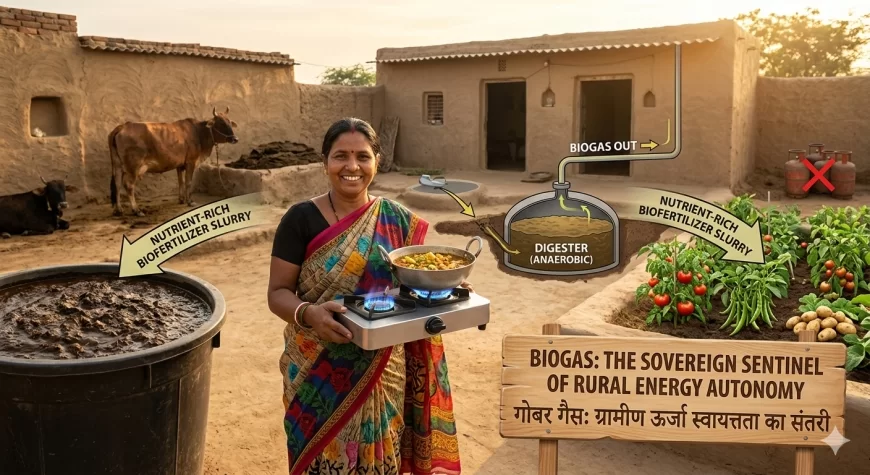
The burgeoning LPG crisis that now imperils the quotidian functioning of innumerable rural households in India has exposed a strategic vulnerability in the nation’s energy security, one that risks rendering domestic life contingent upon geopolitical vicissitudes and the policy choices of distant Western suppliers. In this fraught context, expanding household-level biogas (gobar gas) does not merely serve as an expedient stopgap; it functions as a structurally transformative intervention that restores agency, reduces ecological externalities, and strengthens rural resilience provided that authorities implement it with administrative acuity and fiscal commitment.
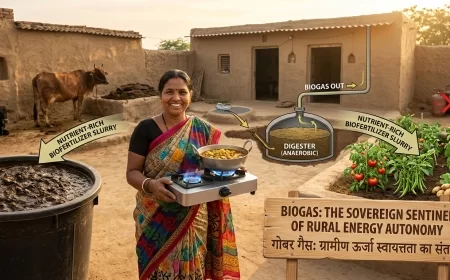
At the epicentre of the problem lies an overreliance on liquefied petroleum gas, a fossil-derived commodity whose supply chains and price dynamics are increasingly volatile. Energy planning has historically excluded rural families, and now they confront constrained access to a fuel synonymous with modernity and convenience, exacerbating inequities and imposing recurrent financial burdens on households already operating on narrow margins. In many districts, intermittent cylinder availability, rising monthly cooking fuel expenditures, and related social anxieties, especially for women, who disproportionately shoulder domestic labour and face unsafe cooking environments, highlight the urgent need for decentralised, renewable alternatives. Biogas, produced from livestock dung and organic waste through anaerobic digestion, offers a compelling confluence of benefits: it is renewable, cost-efficient over the medium term, and amenable to localised production that obviates dependence on long supply chains; crucially, its physical properties being lighter than air and thus dispersing rapidly in the event of leakage mitigate certain fire and suffocation hazards associated with LPG, thereby advancing the cause of women’s safety in domestic spaces.
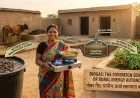
Empirical and anecdotal evidence from rural Maharashtra and other agrarian regions demonstrates the techno-economic promise of household biogas: when targeted subsidies and facilitative bureaucratic processes reduce the one-time capital barrier, families nearly eliminate monthly LPG expenditures and improve indoor air quality. They also generate nutrient-rich biofertiliser as a by-product, enhancing soil health and reducing dependence on chemical inputs.
The New National Biogas and Organic Manure Programme (NNBOMP), with its Central Financial Assistance calibrated to plant capacity and beneficiary category ranging from modest grants to more substantial support for larger units and for marginalised groups exemplifies the policy instruments available to catalyse adoption; in certain jurisdictions, such as Palghar in Maharashtra, the augmentation of central assistance by a Zilla Parishad cess fund of ₹12,000 has demonstrably neutralised the capital barrier for many households, enabling non-governmental organisations to expedite paperwork and installation so that the effective outlay for families becomes negligible. Beyond immediate household economics, the environmental calculus is persuasive: substitution of LPG and, more importantly, of fuelwood with biogas can precipitate substantial reductions in greenhouse gas emissions by capturing methane that would otherwise escape from decomposing dung, and by curtailing deforestation pressures associated with wood fuel collection; studies indicate that household biogas adoption can reduce annual fuelwood consumption by roughly 1,519 - 2,534 kilograms per household, translating into both conservation dividends and marked declines in respiratory ailments attributable to indoor smoke. The ancillary agronomic benefits of generating organic manure that augments soil organic carbon, improves nutrient cycling, and enhances crop resilience further align biogas dissemination with rural livelihoods and sustainable agriculture objectives.
Operationalising a large-scale transition to biogas at the village level, nevertheless, demands more than rhetorical endorsement; it requires a calibrated policy architecture that integrates fiscal incentives, streamlined administrative procedures, capacity-building for masons and technicians, and robust after-sales service to ensure plant longevity. Equally important is the cultivation of social acceptance through participatory outreach: dialogues with farmers and women’s collectives reveal that the requisite feedstock is readily available, cow dung and water suffice for household digesters, and that the perceived benefits extend beyond cost savings to encompass dignity, convenience, and enhanced soil fertility. Scaling up must also be sensitive to heterogeneity in livestock ownership, landholding patterns, and seasonal variations in feedstock availability; where individual household plants are infeasible, community or cluster-based digesters can aggregate inputs and distribute biogas equitably, thereby preserving economies of scale while maintaining local control.
The state plays a pivotal financial role by underwriting the one-time capital cost through a combination of central and state subsidies, complemented by microcredit and NGO facilitation for documentation and installation. This support accelerates the diffusion curve, as pilot districts demonstrate that when authorities eliminate installation costs for beneficiaries, households reduce their monthly LPG bills to zero. From a governance perspective, policymakers can integrate biogas promotion into broader rural development schemes and link it with watershed programmes, livestock extension services, and organic farming initiatives to amplify synergies. This approach ensures that stakeholders do not silo biogas as merely an energy intervention but recognise it as a nexus technology that intersects with health, the environment, and agrarian prosperity.
The strategic calculus is unambiguous: in an era of geopolitical uncertainty and market-driven energy shocks, decentralised renewable solutions such as household biogas confer resilience by localising production, reducing foreign exchange exposure, and empowering rural communities to meet their own energy needs. If policymakers seize this conjuncture to institutionalise subsidies, streamline implementation, and invest in human capital for maintenance and training, biogas can transition from a marginalised technology to a mainstream pillar of rural energy portfolios, thereby ameliorating the LPG crisis at its most vulnerable frontier, the village kitchen, while delivering co-benefits in public health, forest conservation, and agricultural productivity. In sum, the proliferation of subsidised gobar gas plants, undergirded by coherent fiscal policy and community engagement, offers a pragmatic, scalable, and ecologically consonant pathway to mitigate the present LPG exigency and to reconfigure rural energy systems towards autonomy, sustainability, and social equity.
About Authors
1)Ankit Kumar is an edupreneur and development practitioner currently pursuing post-graduation in Rural Development at the Tata Institute of Social Sciences (TISS). His academic interests include rural governance, sustainable development, and community-driven development practices. He is the founder of Ujjalo Sanstha, a youth-led organisation working across education, women’s health, environment, and grassroots social initiatives. His work engages with research and policy discussions on inclusive rural transformation.
2)Anshuman Dey is a postgraduate scholar in Rural Development at the Tata Institute of Social Sciences (TISS). His academic interests centre on rural governance, sustainable development, and participatory frameworks, with a primary focus on underrepresented communities.
3)Rita Poonia is a development practitioner and postgraduate student of Social Work (Rural Development) at the Tata Institute of Social Sciences (TISS). Her academic interests focus on livelihoods, gender, and inequalities in access to resources among marginalized communities.
What's Your Reaction?
 Like
2
Like
2
 Dislike
0
Dislike
0
 Love
1
Love
1
 Funny
0
Funny
0
 Angry
0
Angry
0
 Sad
0
Sad
0
 Wow
0
Wow
0