


















23rd Lecture Series and Annual Talent Honour Ceremony Held under ‘Jamghat’ Programme in Gohana
The 23rd Lecture Series and Annual Talent Honour Ceremony under the “Jamghat” programme was held in Gohana, focusing on social change, development, and the challenges of urbanisation. Speakers highlighted the need for balanced and planned urban growth while addressing issues related to land, migration, and livelihoods in rural areas. The event brought together students, intellectuals, and social activists for meaningful discussion and dialogue.

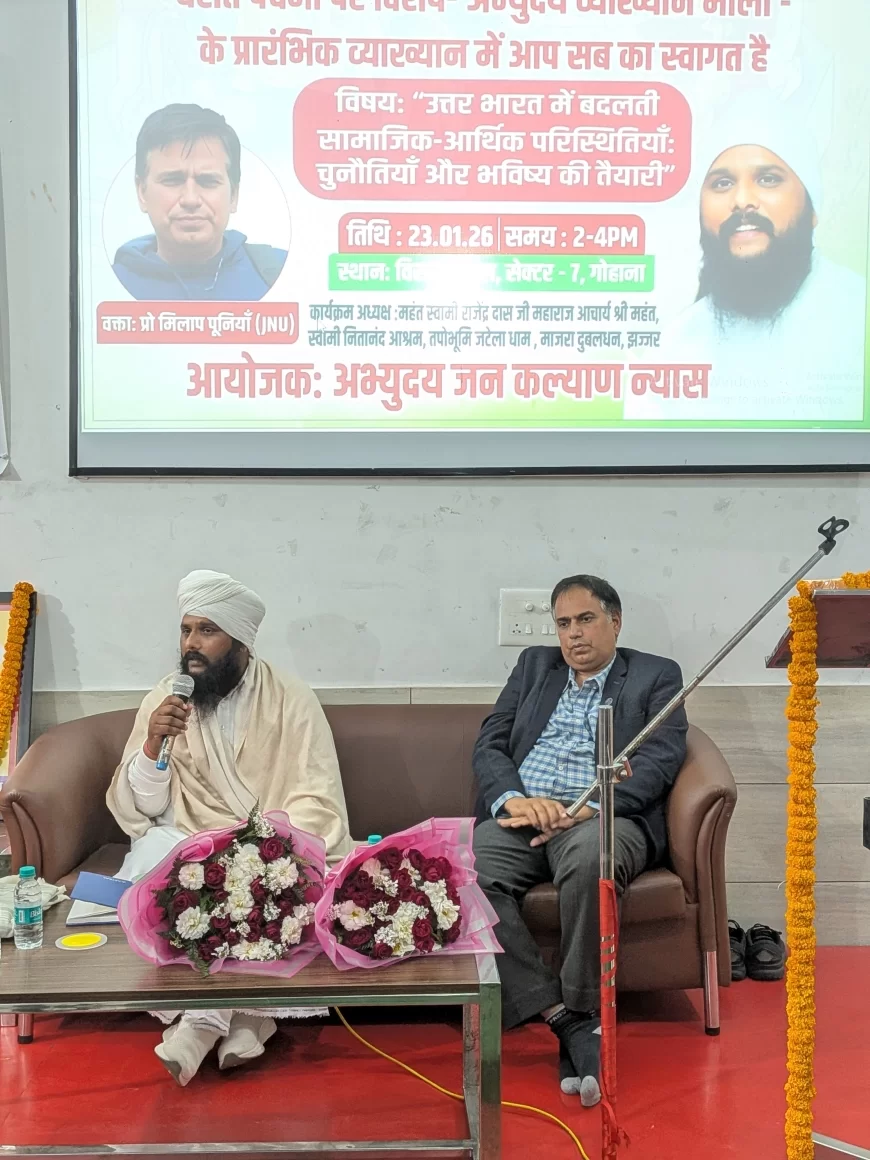
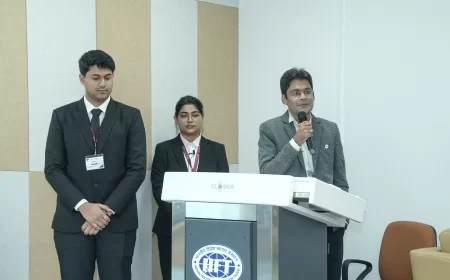
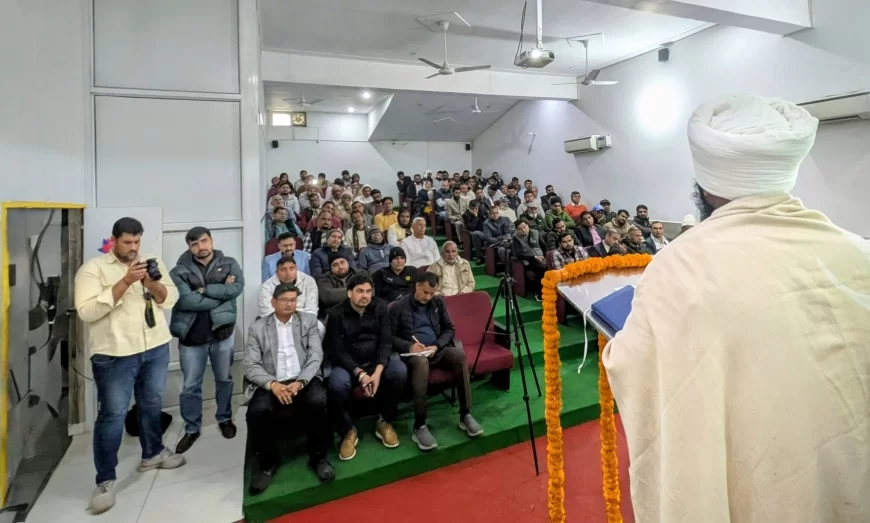
Gohana: The 23rd Lecture Series and Annual Talent Honour Ceremony was organised in Gohana under the “Jamghat” programme of Abhyuday Jan Kalyan Nyas, focusing on social issues, development, and the challenges of urbanisation. A large number of students, intellectuals, and social workers attended the programme.
The event began with the recitation of the Abhyuday Mantra, followed by the lighting of the ceremonial lamp by the guests.
The programme was chaired by Mahant Swami Rajendra Das Ji Maharaj, who in his presidential address stressed the importance of emotional and spiritual values along with social harmony in public life. He said that material development alone is not enough and society also needs moral and human values.
Guests were welcomed and introduced by Dr. Vivek Malik. Speaking about the background and vision of the “Jamghat” campaign, Dr. Yogendra Malik said that the aim of Jamghat is to present complex social issues in simple language and to find solutions through dialogue. He added that the lecture series is an extension of this idea.
The main speaker, Dr. Milap Poonia, said that urbanisation is an important indicator to understand the development of northern Indian states. He explained that although the subject is complex, it must be communicated to people in a simple and clear manner.
Dr. Poonia said that regional studies use a combination of economics, geography, and population science to identify areas that need more development. He pointed out that India is currently facing global challenges related to trade and energy, while different states also have their own development needs.
He shared that in several southern states, the rate of urbanisation has reached 40 to 50 per cent, whereas states like Rajasthan, Bihar, and Haryana still have a comparatively lower rate of urban growth.
Giving the example of the National Capital Region (NCR), Dr. Poonia said it is among the fastest-growing regions in the world. NCR has thousands of villages and a large population, which has accelerated urbanisation and led to a sharp rise in land prices.
During the Jamghat dialogue session, participants from rural areas raised questions related to land, migration, and livelihoods. Speakers said that many rural families are forced to sell land to support their children’s education, which could create future problems for agriculture and employment.
They added that instead of stopping urbanisation, there is a need to promote balanced and planned urban growth so that both villages and cities can develop together.
At the end of the programme, talented students were honoured for their achievements, and the participants resolved to continue constructive dialogue on social and developmental issues in the future.
What's Your Reaction?
 Like
0
Like
0
 Dislike
0
Dislike
0
 Love
0
Love
0
 Funny
0
Funny
0
 Angry
0
Angry
0
 Sad
0
Sad
0
 Wow
0
Wow
0