



















Iran at the Crossroads: War, Nuclear Politics and the Uncertain Future of West Asia
The escalating geopolitical conflict between Iran, Israel, and the US is pushing the Middle East toward a full-scale war, threatening to severely disrupt global energy markets. For India, this crisis raises serious alarms regarding skyrocketing crude oil prices, the future of strategic investments like the Chabahar Port, and the immediate safety of millions of Indian citizens living and working across the Gulf region.

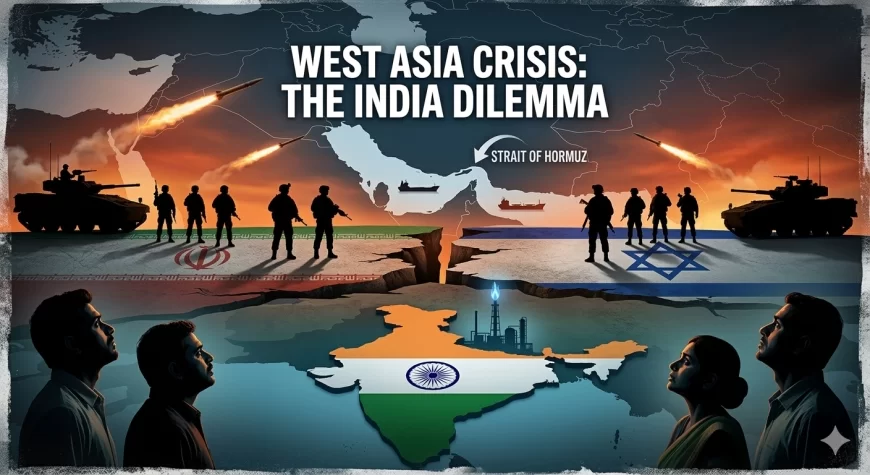
West Asia has once again become the centre of a geopolitical crisis. Rising tensions involving Iran, Israel and the United States have pushed the region towards an uncertain situation. The Middle East has experienced many conflicts in the past, but the present moment is particularly worrying because several sensitive issues are coming together at the same time. These include ideological rivalry, nuclear tensions, regional power competition and the involvement of major global powers. In earlier periods, conflicts in the region were often limited or managed through diplomacy and indirect confrontations. Today, however, the situation appears to be shifting toward more visible and direct military tensions. Missile strikes, drone attacks and threats of retaliation have increased fears that the crisis could turn into a broader regional war. Even a small miscalculation could lead to a chain reaction involving multiple countries and armed groups.
The strategic importance of West Asia makes the situation even more serious. The region holds some of the world's largest oil and gas reserves and plays a crucial role in global energy supply. Major international trade routes also pass through the waters of the Middle East, connecting Asia, Europe and Africa. Because of this, any conflict in the region has global consequences. Instability can disrupt oil supply, increase energy prices and create uncertainty in international markets. Therefore, the current confrontation involving Iran is not just another regional conflict. It has the potential to reshape power relations in West Asia and affect the global political and economic order.
Historical Roots of the Iran Conflict
To understand the present crisis, it is important to look at the historical background of Iran’s relations with the West and with Israel. A major turning point came with the Iranian Revolution of 1979. Before the revolution, Iran was ruled by Shah Mohammad Reza Pahlavi, who maintained close relations with the United States and other Western countries. Iran was seen as a key ally of the West in the Middle East. However, many Iranians were dissatisfied with the Shah’s rule. People criticized his government for authoritarianism, economic inequality and strong dependence on Western support. These tensions eventually led to a large revolutionary movement. In 1979, the Shah was overthrown and Iran became an Islamic Republic under the leadership of Ayatollah Ruhollah Khomeini.
After the revolution, Iran’s foreign policy changed dramatically. The new leadership adopted a strong anti-Western position and openly opposed Israel. Iranian leaders argued that the United States had interfered in Iran’s internal affairs for many years and had supported the Shah’s unpopular regime. Israel, on the other hand, was criticized for its policies toward Palestinians. These ideas became an important part of Iran’s political identity. Diplomatic relations between Iran and the United States were broken, and hostility toward Israel became a central feature of Iranian foreign policy. Over time, this created deep mistrust and long-lasting tensions between Iran and Western powers.
Iran also began building relationships with political movements and armed groups in the region. Groups such as Hezbollah in Lebanon and Hamas in the Palestinian territories developed close ties with Iran. Tehran viewed these alliances as part of its strategy to support resistance against Israeli policies and to strengthen its influence in the region. However, Israel and the United States see these groups as security threats. As a result, Iran’s regional alliances have become one of the main sources of tension in Middle Eastern politics.
The Nuclear Question and the Collapse of Diplomacy
Another major issue at the centre of the Iran crisis is the country’s nuclear program. For many years, Western countries have suspected that Iran may eventually try to develop nuclear weapons. Iran, however, has repeatedly said that its nuclear activities are meant only for peaceful purposes such as electricity generation, scientific research and medical use. This disagreement has led to years of diplomatic disputes and economic sanctions against Iran. In an attempt to solve the problem, a major agreement was signed in 2015 known as the Joint Comprehensive Plan of Action (JCPOA). The deal involved Iran and several world powers including the United States, the United Kingdom, France, Russia, China and Germany. Under the agreement, Iran agreed to limit its nuclear activities. It reduced uranium enrichment levels, limited the number of centrifuges used in nuclear facilities and allowed international inspections of its nuclear sites. In return, economic sanctions against Iran were lifted, allowing the country to rejoin global markets.
Initially, the agreement was seen as a major diplomatic success. It reduced tensions and created hope that the nuclear issue could be resolved peacefully. However, the deal faced criticism from several political leaders who believed it did not go far enough in restricting Iran’s military capabilities. Over time, disagreements and political changes weakened the agreement. The reimposition of sanctions and declining trust between Iran and Western powers led to the gradual collapse of the diplomatic framework. Iran began scaling back its commitments under the agreement, raising fears that nuclear tensions could once again lead to military confrontation. The breakdown of diplomacy removed one of the most important mechanisms for managing the crisis, making the current situation even more fragile.
From Shadow War to Direct Military Escalation
For many years, the conflict between Iran and Israel was largely indirect. Experts often described it as a “shadow war,” where both sides tried to weaken each other through covert operations rather than open military conflict. These operations included cyber-attacks, intelligence activities, sabotage and targeted assassinations. Israel was widely believed to have carried out cyber operations against Iranian nuclear facilities and attacks on individuals associated with nuclear research. The goal of these actions was to slow Iran’s nuclear progress without triggering a full-scale war. Iran responded by developing an asymmetric strategy. Instead of direct confrontation with stronger military powers, it relied on regional alliances and proxy groups to expand its influence. Through these networks, Iran could exert pressure on its rivals in different parts of the Middle East.
In recent years, however, this shadow conflict appears to be becoming more open. Missile strikes, drone attacks and direct military responses have increased the risk of escalation. When conflicts become more visible and direct, the chances of miscalculation grow significantly. One of the most sensitive areas in this context is the Strait of Hormuz. This narrow waterway connects the Persian Gulf with the global ocean and is one of the most important routes for transporting oil. A large portion of the world’s oil supply passes through this corridor. Any military confrontation in this area could disrupt shipping and create a major global energy crisis.
Strategic Calculations of Major Powers
The current confrontation is shaped by the different strategic goals of the countries involved. Each actor believes its actions are defensive, but others interpret them as aggressive. For the United States, preventing nuclear proliferation remains a key objective. American leaders argue that a nuclear-armed Iran could destabilize the Middle East and trigger a regional arms race. The United States also wants to maintain its influence in the region and protect its allies. Israel’s concerns are primarily related to security. Israeli leaders believe that allowing hostile states to develop nuclear weapons would threaten the country’s survival. As a result, Israel has often supported preventive actions to stop such developments before they reach a critical stage.
Iran, on the other hand, sees itself as a victim of external pressure. Iranian leaders argue that the country has faced decades of sanctions, isolation and military threats. From their perspective, strengthening defence capabilities and regional alliances is necessary for protecting national sovereignty. These conflicting viewpoints make the situation extremely complex. Each side believes it is acting to protect its own interests, but the lack of trust makes compromise difficult.
Global Economic and Energy Implications
The Iran crisis also has major economic implications for the entire world. The Persian Gulf is one of the most important energy regions globally. Countries in the area hold large reserves of oil and natural gas that are essential for international markets. Whenever tensions rise in the region, global oil prices often increase because investors fear supply disruptions. Even the possibility of conflict can create uncertainty in energy markets. If the crisis escalates further, energy infrastructure such as oil terminals, pipelines and shipping routes could become targets. Such attacks would affect countries that depend heavily on imported energy, especially in Asia and Europe.
The Strait of Hormuz is particularly important in this context. A disruption in this narrow passage could significantly reduce the flow of oil to global markets and push energy prices sharply upward. Beyond energy markets, instability in the Middle East can also affect global trade, financial markets and political alliances. Rising energy costs and geopolitical uncertainty often place additional pressure on national economies.
Why the Conflict Matters for India
For India, the crisis involving Iran has important strategic and economic consequences. India imports a large portion of its crude oil from the Middle East, and much of this oil passes through the Persian Gulf and the Strait of Hormuz. Any disruption in these routes could increase energy prices and affect India’s economy. India also faces a diplomatic challenge because it maintains relationships with multiple countries involved in the conflict. Over the years, India has developed strong strategic cooperation with Israel, especially in defense technology and security cooperation. At the same time, India has built an increasingly close partnership with the United States. However, India also shares historical and economic ties with Iran. Cultural exchanges, trade relations and regional cooperation have long been part of the India-Iran relationship. Because of these overlapping partnerships, India must carefully balance its diplomacy in the region.
Another important factor is the development of the Chabahar Port in Iran. India has invested in this project to gain access to Afghanistan and Central Asia without passing through Pakistan. The port is considered strategically important for India’s regional connectivity and trade ambitions. If tensions involving Iran increase significantly, the future of such projects could be affected. This would also influence India’s broader regional economic strategy.
India is also concerned about the safety of its citizens working in the Gulf region. Millions of Indians live and work in countries such as the United Arab Emirates, Saudi Arabia, Kuwait, Qatar and Oman. These workers contribute significantly to India’s economy through remittances. If the conflict spreads across the region, ensuring the safety of Indian citizens would become a major priority for the Indian government.
A Turning Point for West Asian Geopolitics
The current Iran crisis represents a critical moment for the future of West Asia. The region has long been shaped by political rivalries, ideological divisions and struggles for influence. However, the present situation shows how fragile the regional order has become. If tensions continue to escalate, the risk of a larger regional conflict will increase. At the same time, the possibility of renewed diplomatic engagement still exists if political leaders choose negotiation over confrontation. The decisions taken by governments in the coming months will play a major role in shaping the future of the Middle East. The consequences will not be limited to the region itself but will also affect global energy markets, international security and economic stability. For the international community, preventing the crisis from turning into a wider war remains one of the most urgent diplomatic challenges of our time.
About the Author
Dr. Rakesh Negi is an Assistant Professor in the Department of Political Science at Hemvati Nandan Bahuguna Garhwal Central University, Srinagar, Uttarakhand. His research interests include Indian politics, electoral behaviour, and international relations. He writes and engages with contemporary debates on geopolitics, foreign policy, and regional security, particularly in South Asia and West Asia.
What's Your Reaction?
 Like
0
Like
0
 Dislike
0
Dislike
0
 Love
0
Love
0
 Funny
0
Funny
0
 Angry
0
Angry
0
 Sad
0
Sad
0
 Wow
0
Wow
0