

























Voice for the Voiceless: MIT ADT University Students Develop ‘OmniSpeak’ to Help Non-Verbal Individuals Communicate
Students from MIT ADT University, Pune, have developed OmniSpeak, a wearable smart glove designed to help non-verbal individuals communicate through pre-programmed voice messages.

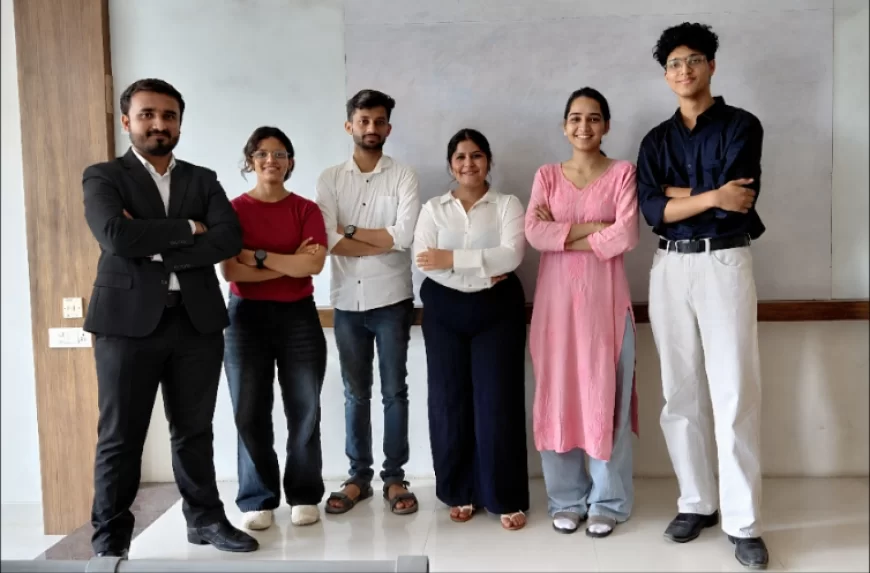
Pune, India: In an effort to use technology to address real-world communication challenges, a team of first-year MCA and MBA students from MIT ADT University, Pune, has developed an innovative wearable device called ‘OmniSpeak’ to help non-verbal individuals communicate more easily.
The project has been developed under the Student Innovation theme of Smart India Hackathon (SIH) 2026. The student team comprises Sagar Pavan Singh, Shreyash Patil, Kashif Ansari, Ashwini Magar, Komal Jat and Gori Kaushik.
An Offline Communication System
OmniSpeak is designed as a self-contained, offline communication system, allowing users to communicate without depending on a smartphone, internet connection or screen-based navigation.
The smart glove uses digital sensing inputs to detect finger gestures and contact interactions. These gestures are then converted into pre-programmed commands that can be communicated through an audio output system.
Powered by ESP32 and Wireless Technology
At the core of OmniSpeak is a dual-core ESP32 microprocessing unit. The system uses ESP-NOW peer-to-peer wireless communication to transmit information from the wearable glove to a secondary receiver.
The receiver incorporates a DFPlayer Mini MP3 module, microSD card and a compact speaker, enabling the device to convert selected commands into audible messages.
16 Pre-Programmed Commands
The current version of OmniSpeak features 16 pre-programmed commands designed to address both everyday communication needs and emergency situations.
These include commands for help, hospital assistance, general emergencies, danger warnings and medical allergy alerts. The system also includes everyday communication options such as asking for directions and communicating with family members.
Focus on Emergency Communication
One of the key objectives of the project is to help non-verbal individuals communicate their needs in situations where conventional verbal communication may not be possible.
By incorporating emergency and medical alert commands, the students aim to make OmniSpeak useful beyond basic communication and position it as a potential assistive technology solution.
Team Working Towards a UK Patent
The student team is currently working to take the innovation further and is pursuing a UK patent for the technology.
The team has adopted the vision “Small Innovations. Big Impact,” reflecting its focus on developing practical technological solutions to address everyday challenges faced by people with communication difficulties.
Plans to Improve the Device
The students are now working on the next stage of OmniSpeak's development. Planned improvements include custom PCBs, lightweight and ergonomic enclosures, and rechargeable power systems.
These upgrades are aimed at making the device lighter, more comfortable, reliable and suitable for regular use.
The OmniSpeak project highlights how student-led innovation can go beyond technological experimentation to address real social challenges, with the potential to contribute to the growing field of inclusive communication and assistive technology.
What's Your Reaction?
 Like
0
Like
0
 Dislike
0
Dislike
0
 Love
0
Love
0
 Funny
0
Funny
0
 Angry
0
Angry
0
 Sad
0
Sad
0
 Wow
1
Wow
1